Saturday, 7 July 2018


The NETHERLANDS and BRUGES – Beers, countryside

and more

Our short trip to The Netherlands and Bruges was fabulous and while I wish we had stayed on longer, we made the best of our short time there.

First stop was Amsterdam and since we arrived past 8.00 p.m., all we had time for was a quick beer and some bites at a neighbouring restaurant, Gent Aan De Schinkel. As it turned out, this would become our ‘go to’ place for a couple more dinners in Amsterdam after a mediocre and overpriced meal in the tourist area of Leidseplein. (Tip: There are tons of ‘Argentinian Steakhouses’ but all of them are far from it.)

Our B&B, a 20-minute tram ride from the city centre, was lovely. There was great attention to detail, generous breakfasts and free use of bicycles as needed, making for a wonderful stay. That it was very close to Vondelpark made it much lovelier as it allowed us to easily stroll and cycle in the park and watch the locals go about their daily lives. Outdoor gym and yoga sessions seemed to be very popular, as well as dogs joining their owners for an evening run!

Visiting the Anne Frank house, Heineken Experience and Van Gogh Museum were the highlights of Amsterdam for us. Thankfully we had booked tickets online well before hand so avoided the queues on the day. The commentary for the museums was very informative. The Heineken Experience was well-curated, especially the interactive exhibits at the end that made for some great family moments. That we were already in high spirits, having downed the free beers that came with the tour (a very generous 3 half-pints each!), likely helped in that regard 😉 

Walking around Dam Square, the Museumkwartier, the Jordaan neighbourhood and the 9 Streets was interesting. We managed to find some great cafes for lunch where we got scrumptious sandwiches and pancakes, while buying the famous Dutch cheeses at one of the morning markets and the cheese shops that were literally around every corner. And of course, one can’t miss doing a canal cruise when in Amsterdam as it gives a great introduction to the city from the water as well as a visit to the famous but not-so-PG Red Light district 😊

We were recommended the Zaanse Schans Windmills, Marken and Volendam tour, which provided a glimpse into the working of windmills, a cheese factory and how clogs are made. However, the tour was too rushed we felt and tour companies would do well to add on another 1.5-2 hours to the tour so that customers can savour each of the towns at leisure. If one has the time, these are doable on one’s own over a day so would recommend that, though would involve slightly more effort.

The highlight of the Netherlands for us though, was the day trip to Delft and Madurodam. The little town of Delft was beautiful and had an old town feel. The Markt was a lovely place to sit, people-watch and catch a performance. We were fortunate to be able to watch the Durham University Brass Band in action. While in town, a short walk to Oostpoort is highly recommended for the lovely views. 

The boys decided to climb all of 375 steps of the tower of the New Church (the 2nd highest tower in the Netherlands) for the views while I shopped around the Markt square for cheese and pottery 😊 It was here that we indulged in our best dessert of the trip – poffertjes - at Willem Van Oranje. Other must-try food while in the Netherlands are Kibbeling (a Dutch snack consisting of battered chunks of fish, commonly served with a mayonnaise-based garlic sauce or tartar sauce), croquettes, bitterballen (a Dutch meat-based snack, typically containing a mixture of beef or veal, minced or chopped, beef broth, butter, flour for thickening, parsley, salt and pepper, resulting in a thick roux) and of course the endless varieties of Dutch cheese.

From there it was on to Madurodam, a theme park, which has all the key monuments in the Netherlands in miniature (built at a scale of 1:25). It was intended to be a happy memorial to George Maduro, built by his parents following his passing at the end of World War II, where he fought the Nazi occupation forces as a member of the Dutch resistance and died at Dachau concentration camp in 1945. 1.5 hours is sufficient to cover the park given its small size. I just had to tick this off the list given my Mum used to talk about it a lot. We managed to buy lovely souvenirs at the shop too before being picked up for dinner with a friend.

Then it was on to Bruges by train where we spent our final two nights and this was definitely the best part of the trip. The Belgian countryside is beautiful and travelling by train allows one to take in all the sights – fields, cattle grazing, windmills, etc. The town itself is absolutely stunning and we thoroughly enjoyed walking through the streets, taking a different route each time. The streets were lined with all kinds of shops with a predominance of gourmet chocolate and some Belgian waffle ones. Need I say more?

Catching two World Cup soccer matches at two different pubs was an amazing experience given how soccer-crazy the Belgians are. And of course, with the awesome, freshly-brewed Bruges Zot beer to go along. In fact, very surprised that I had never heard about this particular beer given that it is so delicious and widely available all over town. In fact, one can do a brewery tour at De Halve Maan where it is brewed, though we didn’t have time. Bieratelier, where one can do a 12-beer tasting session was interesting and very quaint and a lucky find on the way to Minnewater Park and the Beguinhof. Our meals at the oldest café in Bruges, Vlissinghe, and Café Cambrinus (where we tried the famous Flemish beef stew) were great though the service at the latter was terrible! The piece the resistance however, was the fabulous cycle ride through the countryside to Damme where we had the best meal in Bruges at Tante Marie. Viren’s ex-boss offered to be our guide for the trip and we would never have been able to do it on our own so we are really thankful to him. He even guided us in ordering lunch which included the tiny North Sea grey shrimps, croquettes, salmon quiche and the famous Dutch pancakes, Pannekoek, and boy was everything mouth-watering! Stopping along the way to admire fields of barley, corn and potatoes and watch the various water birds tend to their young was simply amazing. Apparently, it was the season for the eggs to hatch and we were fortunate to encounter several bird families with their young. Adorable!! What an ending to the holiday!

So there you have it. Couldn’t have asked for more for my early 50th birthday celebration. Feel blessed. Signing off till the next travelogue…

Tuesday, 6 March 2018

Colourful RAJASTHAN – A dream come true

Our trip to Rajasthan in end-Jan/early-Feb of 2018 was a dream come true and a perfect start to 2018.
Having just 6 nights to explore, we limited ourselves to 3 towns / cities with Kumbhalgarh being the first. Though not a town on most tourists’ lists as there is so much else to see in this vast state, I would highly recommend it, not least because of the Kumbhalgarh Fort, a UNESCO World Heritage Site since 2013. Built during the 15th century by Rana Kumbha and enlarged throughout the 19th century, this was the birthplace of the great king and warrior of Mewar, Maharana Pratap. The perimeter of the wall extends over 36 km long making it the second longest continuous wall in the world, only behind the Great Wall of China. Importantly, the fort remained impregnable to direct assault. A good time to explore the fort is around 4.00 p.m. as one can remain for the Sound and Light Show which takes place every evening from 6.45-7.30 p.m, to see the fort lit up at night. Though we did not have time to explore it, another key attraction is the Kumbhalgarh wildlife sanctuary where night tours are popular. We did however, visit the ‘Hammeripal Lake’ to feed the thousands of African catfish that reside there. It was a sight to behold! 

Kumbhalgarh also dished up two of our best meals of our trip. The first was at the restaurant in The Aodhi Hotel, one of the heritage hotels of India, so comes highly recommended. It was here that we were introduced to ‘laal maas’. It was melt-in-your-mouth delicious to say the least, so more than lived up to expectations. The service was impeccable to boot so it was worth every penny. The second great meal was at a little, nondescript vegetarian restaurant called Shreeji, not far from our abode, the Club Mahindra Fort. This is also considered a heritage hotel, in beautiful surroundings.
Then it was on to Jodhpur, also known as the Blue City for its cerulean-painted houses. One thing about travelling in Rajasthan is that it involves a lot of driving between the different destinations, which can be tiring. We reached Jodhpur by lunch time and headed off to explore the much touted Mehrangarh Fort and Jaswant Thada. As it turns out, they were the most impressive of all the monuments we visited on this trip. The former is one of the largest forts in India, built around 1460 by Rao Jodha, the founder of Jodhpur. One year after his accession to the throne, he decided to move his capital to a more secure location as the 1000-year-old Mandore Fort was no longer considered safe. Entry to the fort is via a series of 7 gates or ‘pols’. There are several palaces within its boundaries famed for their intricate carvings and courtyards such as Moti Mahal, Phool Mahal, etc. The pictures speak for themselves. The museum was fabulous too and is supposedly one of the most well-stocked museums in the state. 
Just nearby is the Jaswant Thada, a cenotaph built by Maharaja Sardar Singh in 1899 in memory of his father, Maharaja Jaswant Singh. It serves as the cremation ground for the royal family of Marwar. The mausoleum is built out of intricately carved sheets of marble which are extremely thin and polished so that they emit a warm glow when illuminated by the sun.
We kicked off Day 2 in Jodhpur with a visit to the impressive Umaid Bhawan Palace, one of the world’s largest private residences. Thereafter it was on to Sardar Market, close to the clock tower, which is one of the major landmarks of the city. The narrow lanes are adorned with shops (estimated to number around 7000!) selling all manner of handicrafts, spices, tea, etc. which made for an enjoyable excursion. The highlight though was the stepwell, Toor Ji Ka Jhalra. Built in 1740s, this historic structure was only recently excavated and restored and will leave you awestruck. No surprise then that it has made it to the list of ‘most beautiful stepwells in India’ (http://www.themysteriousindia.net/12-beautiful-stepwells-india/). We picked up a few pairs of ‘mojaris’ or embroidered, leather shoes and some spices from the market as souvenirs.
After lunch at ‘On The Rocks’ (very overpriced with poor service so stay clear!), we rested at our hotel before embarking on a Bishnoi village safari, one of the highlights of our trip. It was lovely seeing the friendly villagers go about their tasks, with one lady volunteering to be photographed with me (for a small fee😊). Driving from village to village, we were fortunate to see not only several deer in the Guda Bishnoi village, but also the rare black buck, made famous by the Salman Khan poaching case! Another highlight was catching the sunset at the Guda Bishnoi Lake where we saw several migratory birds. A visit to a local dhurrie-maker rounded up our village safari. 
Finally it was on to our final destination, Udaipur. Enroute, we visited the Ranakpur Jain Temple, made of light-colored marble. Over 1444 marble pillars, carved in exquisite detail, support the temple, with no two pillars the same.  The Eklingji temple and the remains of the Sahastra Bahu Temples (not far from Nagda) are also worth a visit. The latter are now in partial ruins, but are still indicative of their original splendour, artisanry and perfect geometry.
Of course, every key city in Rajasthan has its palaces and forts and City Palace,
Udaipur, was the last one we visited.  It was built over a period of nearly 400 years, with contributions from several rulers of the Mewar dynasty, with construction starting in 1553. Having visited the Mehrangarh Fort in Jodhpur, this palace was no match, though admittedly way more impressive from the inside than the outside. Within the grounds, located inside the Fateh Prakash Palace, Crystal Gallery is the largest private collection of crystal in the world. It was established by Maharana Sajjan Singh who ordered the crystal collection from the Birmingham-based F&C Osler company in 1877. Unfortunately, he died before it arrived and all the crystals remain packed in the boxes for 110 years. The Crystal Gallery was opened to the public in 1994 and exhibits precious crystal items brought from various parts of the world, including a dining table, a sofa set and a crystal bed. A must-visit when in Udaipur.
One can’t leave Rajasthan without having eaten dal-bati, so after a quick stop at the vintage car museum, we headed to lunch at the nearby Krishna Dal-Bati Restro. Yummy but boy was it heavy! Definitely called for some R&R before our evening boat ride on Lake Pichola and a romantic dinner at Jhumar restaurant, overlooking Fateh Sagar Lake. After all, Udaipur is called the ‘City of Lakes’ 😊.
Apart from the amazing structures, the best part of the trip was driving through small villages, witnessing the colourful, village life and people first-hand. It was all we expected it to be and more. Our driver, Hari Ram, was amazing at getting us the best photo opportunities with locals in turbans, camels and everything one associates Rajasthan with. Experiences like drinking tea cooked on coals in Busi village and trying my hand at dhurrie-making will forever remain etched in my memory.
So it was with a tinge of sadness that we ended our maiden trip to this colourful state and we hope to return to explore other parts someday…

Monday, 13 November 2017

Welcome to KERALA, “God’s Own Country”

  
Paul McCartney’s comment that Kerala is “truly God’s Own Country” echoes the sentiments of many a traveler to Kerala, the Mantri family included. In fact, this phrase has been adopted by Kerala tourism and anyone wishing to journey to this ‘green’ state should start planning with the help of this website. For foreigners wishing to explore the amazingly diverse tourist offerings of India, Kerala is a great place to start. In fact, we could not get enough of the place on our first visit, hence our decision to visit a second time.

The first time around, we flew into Kochi and explored the city and surrounds. In Kochi, we were hosted by Sunil and Vijaya, close college friends of Viren’s and just as well, since the Bharat Bandh that greeted us on our arrival (welcome to India!) prevented us from sight-seeing. We spent our time instead, exploring the naval base (her husband is a Commander in the Indian Navy) and got to dine on the sailing ship, the I.N.S. Tarangini (on our return), an experience in itself. For the rest of the trip, we chose to stay mostly at hotels from the Casino Group and did not regret our decision to do so given the warm hospitality, personalized service and true Kerala culture on offer.

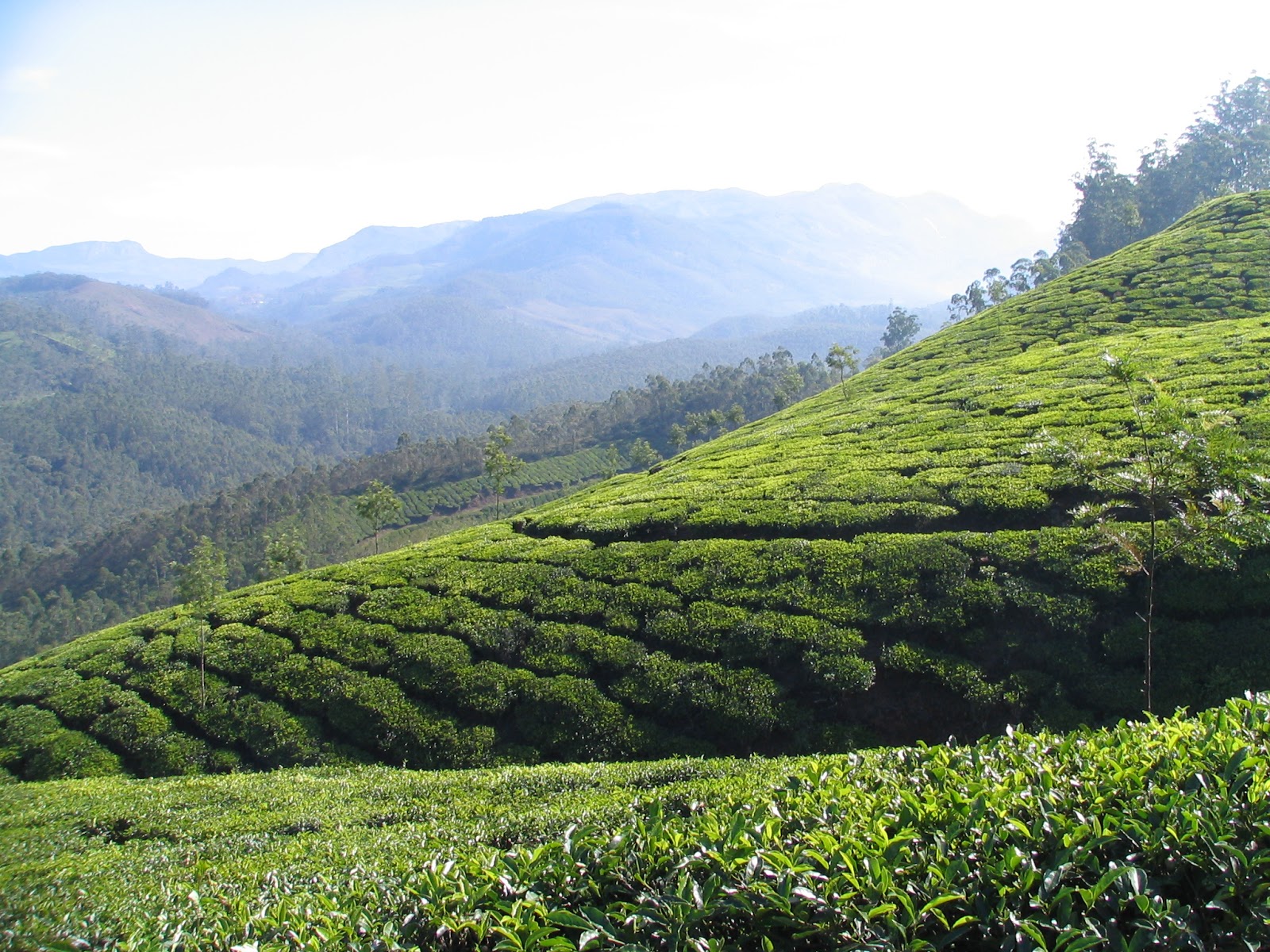
As we embarked on our journey through this wonderful, green state what better place to start than Munnar, with its vast expanses of tea estates, wonderful climate and picturesque scenery. It reminded us a bit of southern Switzerland with the photos likely helping to convince the sceptics. Seeing the Nilgiri tahr in the Eravikulam National Park was enjoyable and this is one of the only couple of places in the world where one can see these endangered, friendly creatures.  From there, it was on to Periyar, where we stayed at Spice Village.  While the Periyar tiger reserve was a bit disappointing, as we did not see any tigers or elephants, the level of service at the hotel and the visit to a spice plantation on an elephant (yes, all three of us on one poor creature J) made up for it.  

The highlight of our stay there though, was the opportunity to see a new-born baby elephant – just 11 hours old when we saw him! He was born to a domestically-owned elephant called Sundari, which led Anand to promptly name him Antariksh (a la Sindoor Tere Naam Ke (an old Hindi TV serial) fame J). It was amazing to see him already walking around, though sticking close to his mum and exploring his surroundings, which included trying to dig a hole in the ground with his little trunk! As word spread about the little fellow, from the next day, curious onlookers were being charged a small fee to observe him. That’s enterprising India for you! Always an opportunity for a business venture 😉 

A stay at Coconut Lagoon in Kumarakom beckoned next, and having featured in the book “1000 Places To See Before You Die”, we were determined to stay there. For us, the place lived up to its reputation though subsequently we have had friends complain about the service standards and quality. In the event, an accommodation that might be worth exploring is Kumarakom Lake Resort, about which we have heard several good reviews. In this area, backwater cruises in the Kumarakom bird sanctuary are enthralling, especially if one is an avid bird-watcher.

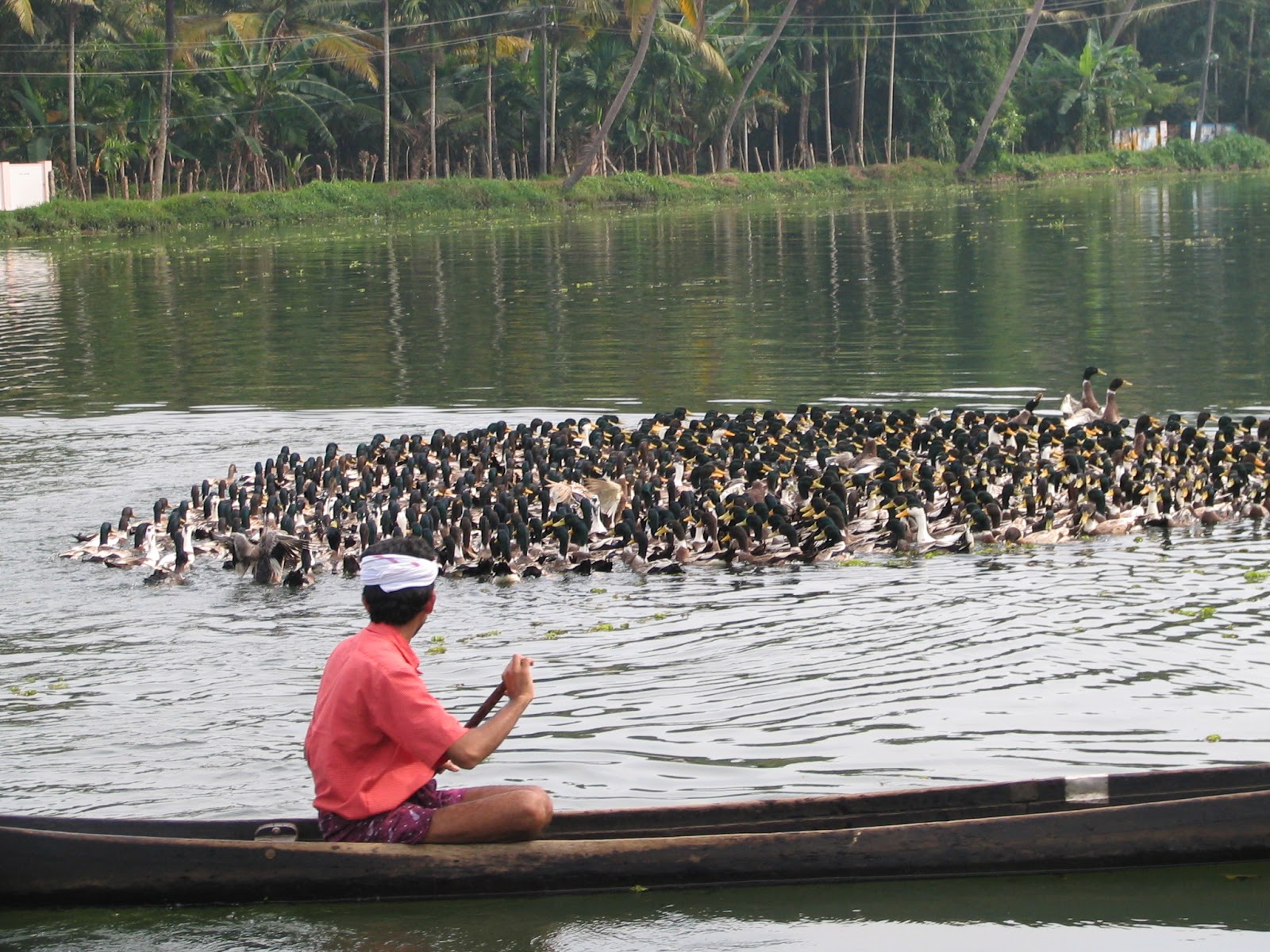
Then, it was on to our last destination – Alleppey – where we explored jungle-shrouded backwater canals on our houseboat. Our captain, Robin, and cook, Matthew Joseph (the food was delicious and homely), were sweethearts and more than made up for the not-so-fancy stay on board. Anyone who visits Kerala should not miss out on this experience as we got a real taste of life on the backwaters up close and personal (the pictures of smiling kids, duck farm, etc speak for themselves). The sunrise in the backwaters was absolutely stunning!

So this rounded off our first trip to God’s Own Country and we knew we would be back for more to explore the southern part of the state. And some years later we did, this time flying into Thiruvananthapuram. Club Mahindra’s resort in Poovar was our abode and from there we explored Kovalam, spending a day at the beautiful grounds of the Taj, as well as Kanyakumari (also known as Cape Comorin). 

The name comes from the Devi Kanya Kumari Temple in the region and it is the southernmost tip of peninsular India. Kanyakumari town is also the southern tip of the Cardamom Hills, an extension of the Western Ghats range. It is especially popular in India for its spectacular and unique sunrise and sunset, thanks to its being nearly surrounded by waters. We embarked on our visit in the wee hours of the morning to catch the sunrise though to our disappointment it was a cloudy day and we missed it. However, the boat ride to see the Thiruvalluvar Statue as well as the Vivekananda Rock Memorial made it worth the trip.


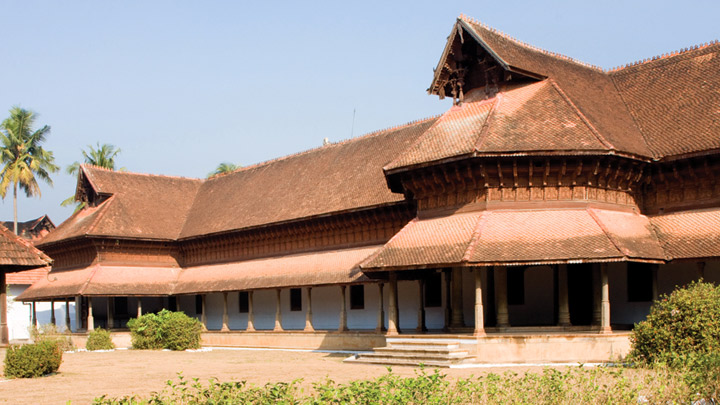
A must-visit when in Thiruvananthapuram is the underrated Puthenmalika (Kuthiramalika) Palace Museum. It means “palace of horses” and has 122 smiling wooden horses all around its structure. Built by a Maharaja of the Kingdom of Travancore in British India, it takes one back to the 1840s when it was first constructed. It is a great example of the Kerala school of architecture and is made from teakwood, rosewood, marble, and granite. The Museum houses idols and sculptures made from white marble, Kathakali figures, Belgian mirrors and paintings. The flourishing spice trade between Kerala and the world made it possible to obtain those items. Maybe it was our fantastic guide who explained everything really well but we enjoyed it better than any other sight-seeing we did in and around Thiruvananthapuram. Unfortunately, it has not been well-maintained. 

The museum is located just near India’s richest temple, the Padmanabhaswamy Temple, the wealthiest place of worship in the world! It is conservatively estimated that the value of the monumental items discovered in the temple is close to US$19 billion and if the antique and cultural value were taken into account, potentially worth ten times the current market price!

Besides its magnificent tourist offerings, Kerala cuisine is delicious and unique and adds another element to one’s visit. Kerala is known as the "Land of Spices" because it traded spices with Europe as well as with many ancient civilizations and this is evident in its cuisine. The region makes frequent use of black pepper, cardamom, clove, ginger, and cinnamon. Traditional Kerala food is vegetarian and includes Kerala Sadya, which is an elaborate banquet prepared for festivals and ceremonies but contemporary Kerala food also includes non-vegetarian dishes. A full-course Sadya (served on a plantain leaf), which consists of rice with about twenty different accompaniments and desserts is the ceremonial meal eaten usually on celebratory occasions including marriages, Onam and Vishu. Grated coconut and coconut milk are commonly used for thickening and flavouring and seafood is a common part of meals.

So pack your bags folks and go explore this green, southern state of India. You will not be disappointed.

Thursday, 9 November 2017

Wining and dining our way through
WESTERN AUSTRALIA


On our recent trip to Western Australia, we drove to the north of Perth (having covered Australia’s South West coast the first time around), towards the laidback fishing village of Cervantes. The key draw for heading there was to see The Pinnacles, limestone formations which are found within the Nambung National Park. The raw material for the limestone of the Pinnacles came from seashells in an earlier era that was rich in marine life. These shells were broken down into lime-rich sands that were blown inland to form high mobile dunes. Visiting at dawn or dusk is recommended with the long shadows formed by the rising / setting sun lending a lovely touch. The Pinnacles are very accessible and there is a 4km loop that one can drive through in a normal 2WD car.

While in the area, a visit to Lobster Shack for lunch and a visit to Lake Thetis is worth doing. While the menu at Lobster Shack is limited, the lobsters are extremely fresh and made for a good first meal of our trip. The next morning, we made a stop at Lake Thetis, one of only a few places in the world with living marine stromatolites, or 'living fossils'. The lake's stromatolites that look like rocky lumps have been dated to about 3370 years old. Following that we drove a bit further north to Jurien Bay for breakfast at the Family Affair Café. The eggs benedict and avocado/feta toast were delicious as was the coffee. Following that, we decided to drive back towards Perth on a different route that led straight to Swan Valley, which was going to be our abode for the next two nights. It turned out to be more interesting than the Indian Ocean Drive on the way up. An interesting stop along the way was the Emu Downs Wind Farm which provides electricity to run the Kwinana Desalination Plant which turns water from the Indian Ocean into nearly 152mn litres (40 million gallons) of drinking water per day!

A 3-hour drive down from Jurien Bay brought us to Swan Valley. Little River Winery for lunch was our first stop (of many!) to do some wine-tasting and have a wonderful meal. We then checked into our wonderful B&B, a beautiful 10-acre property. We were lucky to have the entire place to ourselves. Immaculate rooms, scrumptious breakfasts, a lovely owner, adorable dogs and cats made this two days very memorable. When in Swan Valley, the key thing to do is to eat and drink your way through the 32km food and wine trail 😊 Mandoon, Pinelli and Ambrook wineries were our other favourites.

The few hours we spent in the charming town of Guildford was lovely too and we did one of the heritage walks. Our dinners at Padbury’s and Rose and Crown in this town were our favourite meals of the trip as well.

It was then on to Fremantle. The famous Fremantle Prison was our first stop, being Western Australia’s only UNESCO World Heritage Site.  The ‘Doing Time’ tour was very interesting and our guide Laura was excellent. The tour allows you to explore the cells (scarily claustrophobic with the only allowance for fresh air being the little grooves on the floor below the door!), gallows and other parts of the prison.  Fremantle Prison was constructed between 1851 and 1859, using convict labour. It was initially used for convicts transported from Britain, but was transferred to the colonial government in 1886 for use for locally-sentenced prisoners. Other sites worth checking out are the Round House and the WA Shipwreck Galleries. The Round House was the first permanent building built in the Swan River Colony. Opened in 1831, it is the oldest building still standing in Western Australia. The latter is recognised as the foremost maritime archaeology museum in the southern hemisphere. Steeped in history, the galleries house hundreds of relics from ships wrecked along WA’s treacherous coastline, including the original timbers from the Batavia (wrecked in 1629).
Besides sight-seeing, a spot of shopping never hurts and the famous Fremantle Markets lived up to the hype. The variety of stalls and quality of goods on offer made it the perfect place to pick up mementos from the trip. And finally, while in Fremantle, eating seafood and trying the famous breweries is a must. Little Creatures topped the list of breweries and not only was the beer delicious but the food and service was great as well. Another excellent meal we had was at Kailis’ Fish Market Café which came highly recommended and it lived up to expectations.

What better way to end our trip than with a visit to beautiful Cottesloe Beach, where we were fortunate to be able to catch up with old friends over lunch. So before we knew it, we had wined and dined our way through an entire week and it was time to say good-bye. Definitely won’t be our last trip to the country with the Barossa wine region beckoning next 😊 You see a theme here? 😉

Wednesday, 10 May 2017


Our GREAT CHINA sojourn


Just back from an amazing trip to China, our first to the country. The sight-seeing, infrastructure, food and shopping surprised on the upside and we are definitely planning on returning to savour the other parts this vast country has to offer. For now, let me give you an insight into our maiden trip…


We decided to kick off our China adventures with a 4-day stay in Beijing and we couldn’t have chosen a better hotel at which to do that. The Fairmont Beijing was amazing - especially the extremely helpful concierge staff who helped book taxis, provided good tips, etc. Despite arriving well before the check-in time, the room was ready for us so that we could rest and freshen up before starting to explore the city. We headed to the Forbidden City - the Chinese imperial palace from the Ming dynasty to the end of the Qing dynasty, which now houses the Palace Museum - on Day 1 itself being a Friday, as this attraction gets absolutely crazy on the weekends, with millions of people descending on it. The place was massive to say the least, covering an area of 72 hectares and housing the largest collection of preserved ancient wooden structures in the world. It is said to be the most visited art museum in the world. The view of the Forbidden City from the highest point in Jinshan Park is well worth the effort. Spring is the best time to visit with the flowers in full bloom adding to the magnificence.


The Temple of Heaven was my favourite in Beijing though (apart from the Great Wall, of course) with the geometry and colours very impressive. The temple grounds cover 2.73km.sq. of parkland and comprise 3 main groups of constructions: The Hall of Prayer for Good Harvests, The Imperial Vault of Heaven and The Circular Mound Altar. The centre of the altar is a round slate called the Heart of Heaven (天心石), where the Emperor prayed for favourable weather. Thanks to the design of the altar, the sound of the prayer will be reflected by the guardrail, creating significant resonance, which was supposed to help the prayer communicate with Heaven. We did try our luck at the Echo Wall but it was impossible to test given the loud tour guides and crowds 😊 Next up on the list was the Laoshe Teahouse, great for experiencing Chinese tea culture. However, be prepared to pay a decent sum . Following that was the Da Dong Roast Duck restaurant to try the city’s most famous dish, Peking Duck. However, the service and the duck disappointed greatly with Singapore’s Imperial Treasure Super Peking Duck restaurant doing a far superior job.

We kick-started Day 3 with a visit to the Summer Palace, which is an essential on every tourist’s ‘must-do’. It is a vast ensemble of lakes, gardens and palaces, dominated by Longevity Hill and has been declared by UNESCO as "a masterpiece of Chinese landscape garden design”.  Do try to visit on a weekday to avoid the crazy weekend crowds. A boat ride on the Kunming Lake is a great way to get shots of the palace from a different perspective. 

In the latter part of the day, we took a tour of the hutongs in Beijing and it was very interesting. 
Hutongs are alleys formed by lines of siheyuan or traditional courtyard residences. Since the mid-20th century, a large number of Beijing hutongs were demolished to make way for new roads and buildings. More recently, many hutongs have been designated as protected, in an attempt to preserve this aspect of Chinese cultural history. The pedicab ride through the hutongs was the highlight with our driver quite crazy and having us thoroughly amused throughout 😊

We left the best for last, a visit to the Great Wall at Mutianyu. While hordes of tourists descend on the Badaling part of the wall, I would highly recommend people do Mutianyu as it is less crowded and way more scenic. We had a lovely guide to take us there by car and we opted for the round-trip cable car ride to the top to spend more time exploring the wall itself. The more adventurous might choose to climb to the top of the wall by the stairs. While I explored only a few watch towers, hubby climbed to the highest permissible watch tower on the left side (number 23) where he was pleasantly surprised to be able to buy a chilled Tsing Tao to reward him for his effort 😊 (FYI, Tsing Tao the most popular Chinese beer) He swears to be back with Anand to run the Great Wall marathon. All in all, left Beijing very impressed with the beautifully maintained sights and efficient infrastructure.

It was on to Shanghai by the high-speed train for the second half of our trip. Would highly recommend this mode of transport wherever possible in China as opposed to domestic flights for its punctuality and comfort, though it is often more expensive. One can choose either first class or second class seats and both make for a very comfortable journey. In Shanghai, we were focused on spending quality time with family and shopping. A heartfelt thanks to my cousin Nika and her family for filling our sojourn there with wonderful memories to last a lifetime. An evening walk at the Bund and a visit to Yu Garden was all the sight-seeing we managed to squeeze in there.

When in Shanghai, day trips to Hangzhou and Suzhou are highly recommended. In fact, the former was the highlight of our entire trip for me along with the Great Wall. It is the 4th largest city in China with the West Lake its best-known attraction. However, it was walking in the old part of town, eating traditional food at a local restaurant and visiting the grounds of the beautiful Four Seasons Hotel that contributed in equal measure to the whole experience. Having lovely MinMin as our guide of course made all the difference. She even took it upon herself to be our photographer, getting us to pose for romantic shots wherever possible, making us feel like we were on our honeymoon! 😊 Hubby was super impressed with the bike paths everywhere and who knows? We might be back someday.

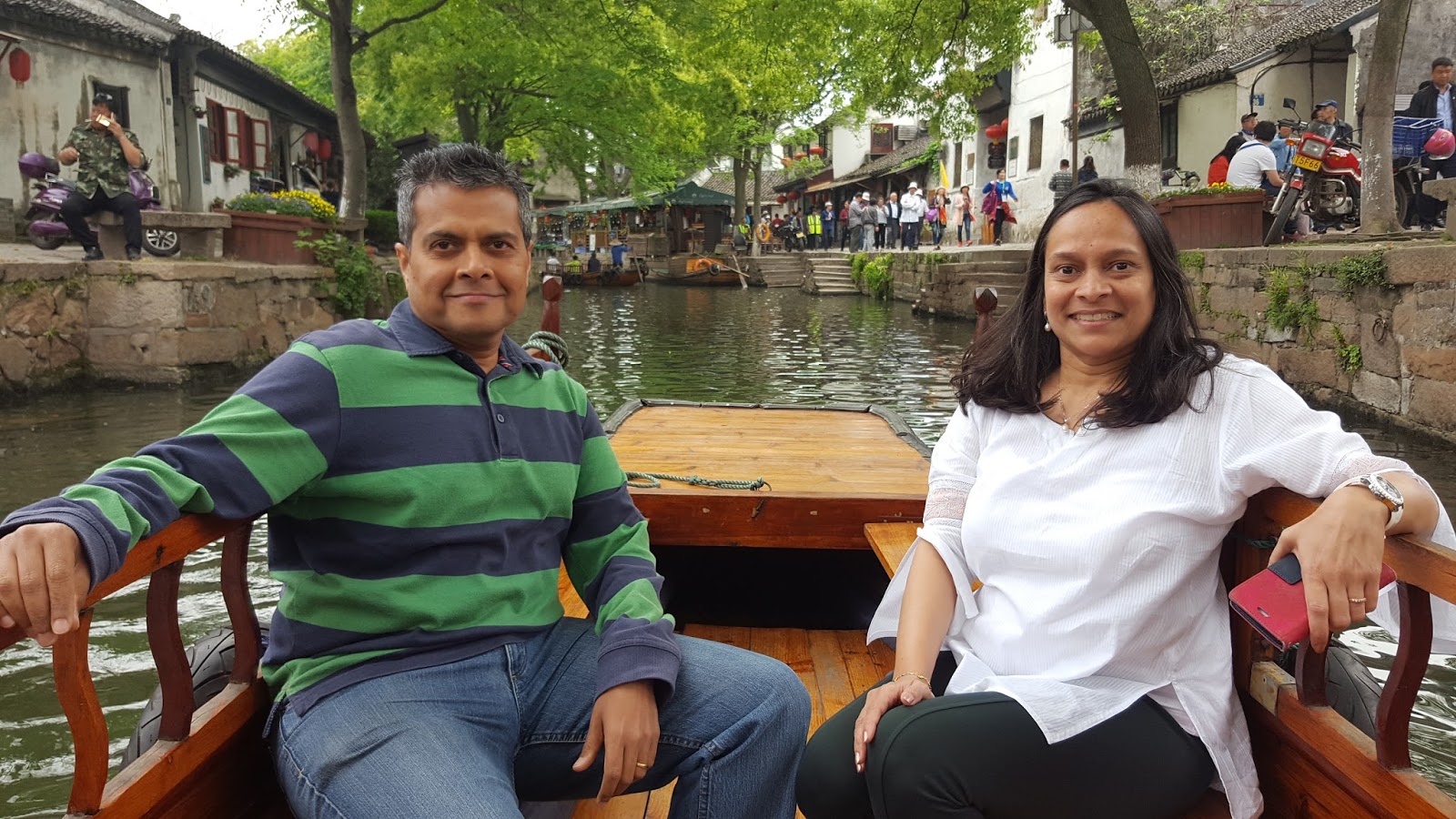
Suzhou meanwhile is famous for its gardens. The guide took as to The Lingering Garden which was beautiful, more so because of the various traditional Chinese performers throughout the park – a flautist, a lady playing the pipa, a Chinese opera performance, etc – taking one back in time. Tiger Hill – a Leaning Tower of the orient of sorts – was impressive too and the walk back to the entrance through the canopy of trees, watching numerous egrets tending to their nests, was delightful. Then it was on to the highlight of the day, a trip to the water town of Tongli. Truly like experiencing an ‘oriental’ Venice. We took a gondola ride to get a feel of the town and then spent an hour rambling through the quaint streets and shops, watching the local people go about their lives. The most intriguing was seeing a fisherman getting his cormorants to fish for him.

The food in China was fantastic and we got to savour cuisines from all over the country. While we did hear a lot about the pollution, especially in Beijing, we lucked out with decent weather and pollution levels throughout the trip. We’ll be back for sure.

April 2017 - Beijing, Shanghai, Hangzhou, Suzhou (China)